
“Easy to Work With” Was Never a Compliment
It Was a Warning Sign
There’s a version of you that shows up in meetings and says the “right” thing instead of the true thing. Who rewrites the email a third time so no one reads it wrong. That says “yes” before checking whether there’s anything left to give.
This version gets promoted, praised, called a team player.
Nobody claps for the version underneath. The one whose shoulders are up around her ears by 10am and doesn’t know why anymore.
You’re allowed to stop pretending she’s “fine.”
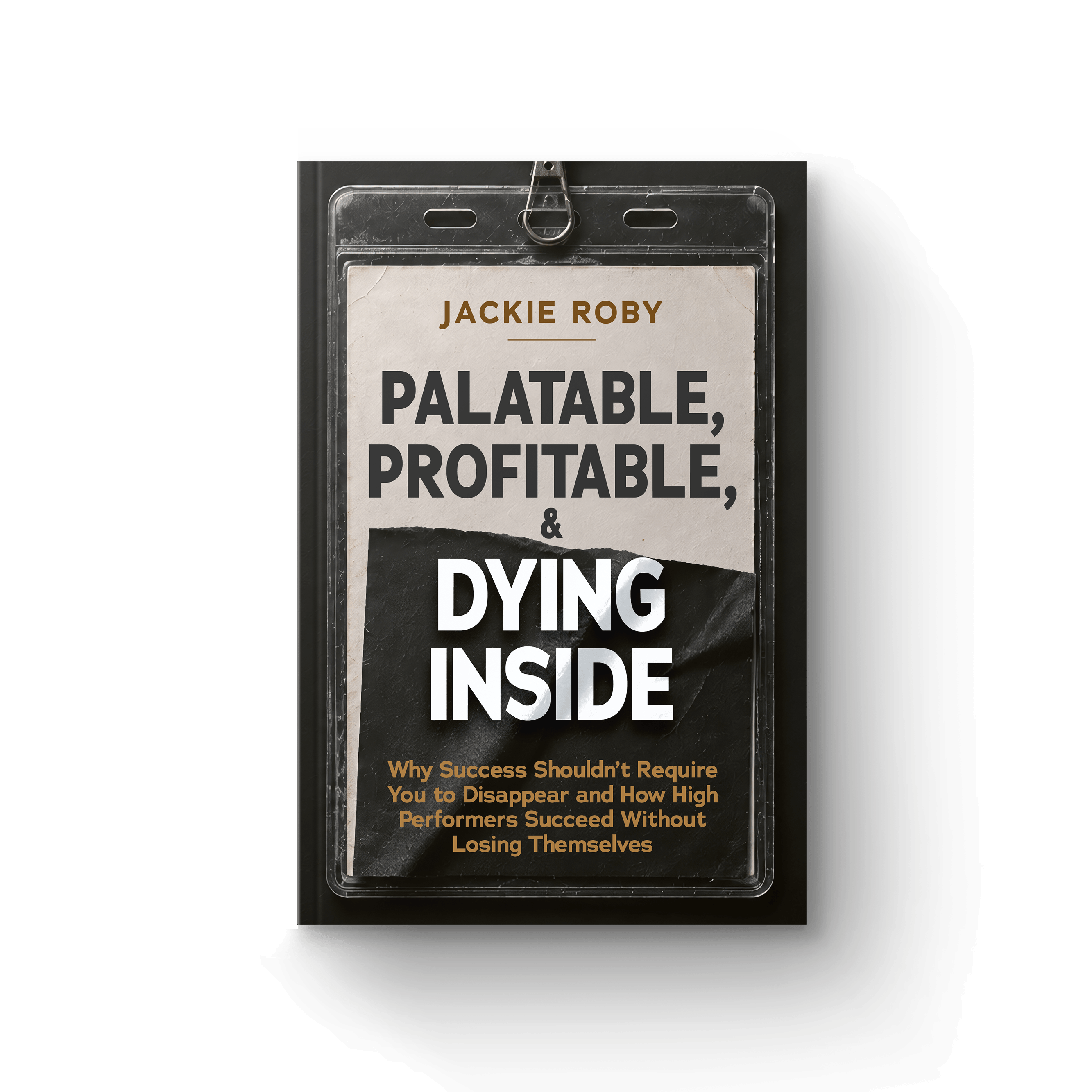
Palatable, Profitable, and Dying Inside is for her.
Be Among the First to Read It
Palatable, Profitable, & Dying Inside:
Why Success Shouldn’t Require You to Disappear and How High Performers Succeed Without Losing Themselves
Written for the professional who’s tired of being easy to get along with, and the leader who’s wondering where all the honesty went.

This Might Be You
Your manager asks if you can take on one more thing. You’re already at capacity. But turning it down might read as not being ready for the next level, so you say “yes” and figure out the rest at eleven at night.
Or you’ve got the third draft of an email that said the same thing the first draft said, just softer. The apology you added to a sentence that didn’t need one. The question you didn’t ask because you already knew how the room would receive it.
None of this looks like a problem. It looks like professionalism. It looks like being good at your job.
Here’s what it actually is: a system you built, one calculation at a time, to keep yourself safe by keeping yourself smaller. And it worked, for a while. You established a great reputation, a reliable asset. The sense that you belonged.
What it also did was subtly move your real thinking somewhere no one could see it, including you. And now the room lost your ideas, objections, and authentic perspective.
What This Book Names
This book calls it palatability: learning to dilute yourself so other people will accept you, reward you, and keep you around, even when doing so costs them access to what you really think.
Palatability isn’t the same conversation as burnout, confidence, or people-pleasing, and it isn’t solved by any of the usual fixes for those things. You can be confident and still edit yourself in a meeting. You can set boundaries at home and still can’t say “no” to your boss. You can love your job and still feel yourself disappearing inside it, one smoothed-over sentence at a time.
Palatability is proof you read your environment accurately and adjusted, the way anyone would if the room made clear that being easy to get along with was safer than being honest. The strategy worked. That’s exactly the problem. A strategy that once protected you can keep running long after the threat that built it is gone, erasing the parts of you that made you worth hiring in the first place.
This book names how that pattern gets built, what keeps it running, and what it costs you, your relationships, and the organizations that never got your full thinking in the first place.
Why This Matters in Organizations
Palatability Culture happens gradually because the early signs look like success.
It starts with overextension. High performers say “yes” by default, absorb the extra project, answer the message long after the business day ended.
Then it gets quieter. The people who used to challenge a plan instead ask how to execute it. Meetings lose their friction.
By the time leadership notices, it’s often labeled as a retention problem or a talent-pipeline gap. The exit interview doesn’t explain why your best person left, because she left the day she decided speaking up wasn’t worth the cost. The paperwork just caught up.
Gartner’s 2025 research on workplace culture found the share of employees willing to recommend their organization as a great place to work fell from 35 percent in 2022 to 26.5 percent in 2025, while the disengaged share climbed to 41.4 percent.
This book shows organizations don’t automatically receive their people’s full capability. They receive the portion people believe they can safely contribute. The question worth asking in any leadership meeting is whether your culture is receiving compliance or contribution, and whether you’d know the difference if you saw it.
About the Author
Jackie Roby spent two decades in high-pressure, performance-driven industries, hospitality, corporate sales, leadership, watching the same pattern play out from the inside. The behaviors that got people rewarded were often the same ones costing them their voice, their health, and their best ideas.
She lived it herself. As one of the few Latinas in rooms that expected her to disappear, she built a career by managing her own mental health in spaces that made no room for it, and by learning exactly what it costs to stay easy to work with.
Jackie is the founder of Inspired Journey Consulting, where she advises executives and high-potential leaders on decision quality, psychological safety, and the organizational cost of self-silencing. She chairs the Global Wellness Institute’s Inclusive Wellness Initiative and has spoken to audiences from Boston to Dubai to Mexico.
Palatable, Profitable, and Dying Inside is the book she needed a decade ago, and the one she now brings to the leaders and professionals still looking for it.